By David Shaw
I read a lot about information and knowledge management. Often it seems airy-fairy. By this, I mean, how do you implement it in the real world? Many people think you just go out and buy a knowledge-management system (KMS).
There! Another check box ticked. And another enterprise system destined for an expensive failure.
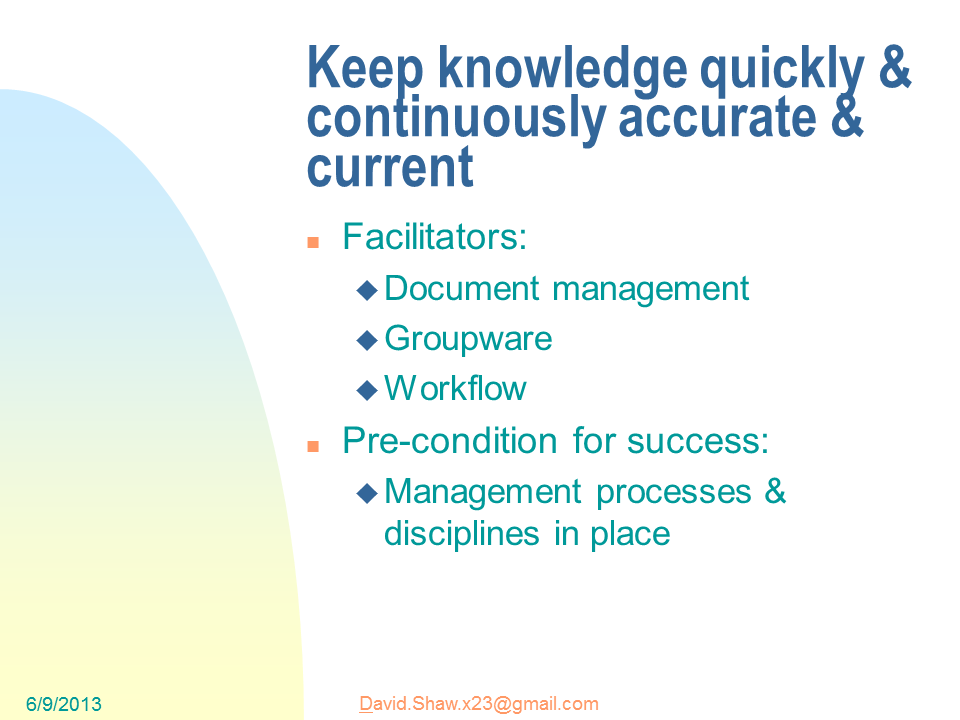
So this month I have a few slides for you taken from my workshop on knowledge management. Hope they give you some concrete ideas.
Showing posts with label knowledge management. Show all posts
Sunday, June 9, 2013
Monday, April 8, 2013
Learning Management Systems are a Cloudy Commodity
By David Shaw
Industry statistics show that overall IT departments spend
80% of budget on maintaining core data-centre technology and only 20% on the applications
(e.g., an LMS) that deliver the real value for an organization. IT is a cost
centre, not a strategic asset.
It’s worse with eLearning. Our experience is that
successfully implementing and managing an LMS/LCMS is beyond the capability of
most IT organizations. Yes, they can install it and get it running but beyond
that they simply don’t have the domain experience. Their experience is in structured
data (databases) and they regard courseware as unstructured data. Worse, they
believe eLearning is essentially PowerPoints running on a web server; they
don’t know how to stream video on the intranet; they won’t support half the
file formats common in eLearning courseware; and they’re too concerned about
Bring Your Own Device to even think about mobile courses.
Cloud Computing can change this.
Like mobile it seemed that Cloud Computing would always be
out there somewhere, always several years in the future. But in the same way consumers
pushed mobile computing into the enterprise without IT, they are consuming and
promoting cloud computing in many guises and bringing it into rogue business
units. Here are just a few examples of Cloud Services that you may have used or
heard about:
- Automatic upgrades of software on your computer
- Amazon, FaceBook, Google, Yahoo, YouTube and others reside on vast globally distributed Cloud Computing platform
- Stores like Apple iTunes, Google Play, Windows Store
- File hosting services like Box, Dropbox, Flickr, Google Drive, iCloud, Instagram, Microsoft (Live) SkyDrive, UbuntuOn
- Free eMail services like Hotmail (Live Mail), Gmail, Zoho Mail, AIM Mail, iCloud Mail, Outlook, Yahoo!, and a dozen others
- Online backup services like IDrive, KinectD, MozyHome, Nero, Norton
- Google Docs, Microsoft Office 365, Zoho office tools
- Google Chromebook cloud computers
- Windows 8 pushing users onto the MS Cloud as the default
- Apple pushing users onto iCloud
- Microsoft’s Lift London studio developing new games exclusively for the cloud
- Wix is a really cool cloud service for developing web sites
What these have in common is that they are a form of Cloud
Computing called Software as a Service (SaaS). Other cloud types not discussed
here (and potentially of greater interest to the IT department) are Platform as
a Service (PaaS) and Infrastructure as a Service (IaaS).
What does SaaS mean for eLearning? There are four basic ways
for an organization to operate an LMS or LCMS:
- Internal Hosted
- Hosted Service
- Shared Service
- Software as a Service
Internal Hosted is a non-cloud single-tenant model. This is the traditional scenario where an
LMS/LCMS is implemented and hosted by an IT department or business unit on
local servers. The main advantage is direct control over governance and
security. The disadvantages are lengthy and difficult procurement processes,
and the need for capital investment that may be hard to get. Capacity is always
a step function, so you capitalise servers over the forecast demand or
experience loads that cause reduced service from too little capacity.
\
Hosted Service is also a non-cloud single-tenant model. This
is the same as Internal Hosted except that it has been outsourced to a service
provider who supplies the servers and manages the LMS/LCMS software
application. This is sometimes called Managed Service. The servers can be
located on premises or externally, depending on the arrangement. The advantage
is that you don’t need IT approval for a capital expense because this is usually
a leased service. The disadvantage is that you do need IT approval. This model
also suffers from over- or under-capacity issues.
Shared Service is a non-cloud several-tenant model. This is
an Internal Hosted model in which a few separate business units or
organizations share a software application run by a centralised service
provider to reduce costs. For example, enterprise web applications like Drupal,
Joomla, SharePoint, WebSphere, WordPress and many others can be used to set up
more than one web-site domain.
Typically partitioning of user data and content is very
weak. Typically the oversight model is weak and bureaucratic. Often the users
do not have end-to-end ownership of process. Security and governance, including
content approval, are often subject to the business processes and delays of the
chief business owner. New functionality, performance levels, service-level
agreements and changes to the service are difficult to negotiate. This model
also suffers from over- or under-capacity issues. It’s a popular government mantra
but only a few practitioners have shown significant cost savings.
Software as a Service is a multi-tenant cloud model. This is
an external software application from a service provider that runs on top of a
stack of PaaS and IaaS cloud services. SaaS uses hypervisor virtualization to
separate tenants. The software and database are architected for multiple
tenants with strong partitioning of user and content data.
Security is managed by the SaaS provider. For protection, usually
data is fragmented across several geophysical locations and often encrypted.
The service-level agreement may be standard and difficult to customize. There
is no capital cost – a major benefit. This model matches capacity to demand
dynamically, and charges only for usage.
However, under the Electronic Communications Privacy Act of
1986, the Patriot Act of 2001 and the Foreign Intelligence Surveillance Act of
1978/2012 the US government can still access any data without a warrant if it
is stored in the USA or if the service provider falls under US jurisdiction.
Access does not have to be for reasons of national security – the legislation
allows warrantless access for political and economic reasons, too.
Also, as an
aside, any email stored in the USA over 180 days is not private or privileged.
In 2013 the FBI’s priority was to get new powers under the 1994
surveillance law called the Communications Assistance for Law Enforcement Act.
The FBI wants the power to mandate real-time surveillance of email, cloud services,
or online chat providers like Skype. This is everything from Dropbox and online
games to Live Mail, Outlook Mail, Gmail and Google Voice.
As a simple matter of due diligence and security from
economic espionage data should not be stored with US service providers unless
extremely strong encryption is used on the client-side (keys should not be
stored in the cloud). This is a thorny issue for service-level agreements.
Some of the benefits of SaaS are:
- Lowering the opportunity cost of running technology. Opportunity cost is the cost of not doing something, thus foregoing future benefits.
- Allowing for a shift of costs from capital expenditure to operating expenditure, which makes it much easier to acquire technology.
- Lowering the total cost of ownership (TCO) of technology (resources are pooled).
- Giving organizations the ability to add business value by renewed focus on core activities by spending 20% on core technology and 80% on better business applications.
- Enabling IT to focus on the strategic aspects of its role.
- Empowering small- and medium-sized organizations through access to global-scale technology at utility prices.
The National Institute of Standards and Technology (NIST) has
defined several essential characteristics for a cloud service:
- On-demand self-service so an end user can sign up and receive services without the long delays that have characterized traditional IT.
- Broad network access via standard platforms (desktop, laptop, mobile, etc.).
- ·Resource-pooling across multiple customers who share bandwidth, load balancing, servers and databases.
- ·Rapid elasticity so the service can scale to cope with demand peaks. This means the service level is always matched to the demand so you don’t pay for over-capacity or lose users from under-capacity.
- Measured service with billing metered and delivered as a utility service the same way we consume electricity and water.
Some so-called cloud services charge by the number of users
but we would argue that this is just a form of hosted self-service. A true
utility service, e.g., electricity, doesn’t care how many people are in the
house.
An LMS is a good candidate for SaaS. At this time there are several hosted self-service LMS providers: Articulate Online, BizLibrary CompanyCollege LMS, Docebo Cloud, ePath Learning ASAP, Epignosis LTD, eFront Enterprise LMS, Zenler Online and probably more.
An LMS meets some of the criteria for a cloud service, such
as:
- It is not a differentiating or core business application
- It is usually web-facing
- Users need access from desktop, laptop, mobile, etc.
- Demand can be spiky when training campaigns are underway
- Global delivery through content-distribution networks
- It can be managed by business departments
An LCMS is not a good candidate for SaaS. It meets some
criteria for not using a cloud service,
such as:
- It is not web-facing (it’s a back-end system to a web-facing LMS)
- It does not have to scale rapidly to meet demand
- It is a value-added service that differentiates the organization (especially with content re-use)
- It involves uploading many and often large files that consume bandwidth
Tuesday, August 3, 2010
Available as an eBook -- Indie Writers & Social Media
Greetings:
The five-part series on indie writers is available as an eBook in ePub format for anyone who wishes to request it of me.
ePub is compatible with hardware eBook readers like the iPad and Kindle and software readers like Calibre, FBReader and Stanza. Personally I use an ePub plug-in for the Firefox browser.
Cheers.
The five-part series on indie writers is available as an eBook in ePub format for anyone who wishes to request it of me.
ePub is compatible with hardware eBook readers like the iPad and Kindle and software readers like Calibre, FBReader and Stanza. Personally I use an ePub plug-in for the Firefox browser.
Cheers.
Tuesday, June 22, 2010
Indie Writers & Social Media - Part 5
David Shaw © 2010
As Alice said, "I lost count," when the White Queen asked, "What's one and one and one and one and one and one and one and one and one and one?"
You’ll never have time to write that best seller!
Maybe you should open a co-op bookstore….
Obviously part of the solution is to collaborate. One person might have an interest in developing a specific skill, and another another, and another another, until you lose count.
But what if you…
Also, collaborating online is not conducive to cross-training. There’s a lot more “throw it over the wall” going on, and fewer opportunities to share technical skills. Not everything can be put into words.
So this is my idea. Independent writers join together in a club or association for the purpose of collaborating in the many skills required to be successful. I think there should be a physical meeting place, a kind of drop-in centre in some ways, and also a production centre where writers can access tools and be trained in their craft.
Location is important. It should be visible to the public, and encourage community involvement. That’s why I’m calling it a bookstore. A location next to a college or university might be ideal. In my town, I would put it on the main drag between a coffee shop and a print shop.
One of the important functions of the co-op would be to function as an umbrella publisher and promoter for the group using some of the techniques discussed in Parts 1 through 4.
The next blog article will be the start of a new series addressing social media and some other type of business.
What I Tell You Three Times is True
Well, if you follow the strategy for indie writers outlined in Parts 1 through 4, you will be a busy little beaver. What with acting as a publisher and public-relations expert; developing and executing engagement strategies for social media; developing single-source production; writing a blog; and wittering about your terribly bad-hair week.As Alice said, "I lost count," when the White Queen asked, "What's one and one and one and one and one and one and one and one and one and one?"
You’ll never have time to write that best seller!
Maybe you should open a co-op bookstore….
Return of Craft
It’s possible to be an indie writer today because of the return of craft. The tools of writing and publishing have become accessible because of the digital and network revolution we have experienced, driven by Moore’s Law and the vision of Steve Jobs. For example:- The Apple Macintosh revolutionised film and sound production, making it possible for one person to edit and master a commercial film on one machine. Singer Buffy Sainte-Marie was one of the first to take music production to an indie craft level using an early Macintosh. Today you can storyboard and edit a movie with a $20 digital-clapboard application on the iPad.
- In manufacturing, you can design a physical gizmo using open-source CAD software from Google, and produce a working prototype using an inexpensive desktop 3D printer. A year ago small 3D printers were $15,000; now you can get desktop models for $1,500 or less. Once you’re satisfied with the prototype, you can send the CAD files to one of thousands of low-volume manufacturers in China and have batches of one to several thousand made.
The Challenge
But it’s a lot of work, and we don’t all have the multi-faceted talents needed to pull this off successfully. Some of the challenges an indie could face include:- Access to editors and peer reviewers
- Promotion and social-media smarts
- Production expertise in the technology of small-scale single-source publishing
- PDF and ePub production
- Collaborators to provide voices for audio books
- Book design and typography
- Expertise in producing video trailers for YouTube
Obviously part of the solution is to collaborate. One person might have an interest in developing a specific skill, and another another, and another another, until you lose count.
But what if you…
Open a Co-Op Bookstore
There are all kinds of models for collaborating online. Some things are easier than others to do online. You can share a work in progress, and get reviewers’ comments, but the final polishing might be easier with a face-to-face discussion.Also, collaborating online is not conducive to cross-training. There’s a lot more “throw it over the wall” going on, and fewer opportunities to share technical skills. Not everything can be put into words.
So this is my idea. Independent writers join together in a club or association for the purpose of collaborating in the many skills required to be successful. I think there should be a physical meeting place, a kind of drop-in centre in some ways, and also a production centre where writers can access tools and be trained in their craft.
Location is important. It should be visible to the public, and encourage community involvement. That’s why I’m calling it a bookstore. A location next to a college or university might be ideal. In my town, I would put it on the main drag between a coffee shop and a print shop.
One of the important functions of the co-op would be to function as an umbrella publisher and promoter for the group using some of the techniques discussed in Parts 1 through 4.
Next Time
This is the final article of five in this series for independent writers. Hopefully it has included some useful ideas. Many of them had little to do directly with social media; however, social media cannot be discussed without an understanding of the greater social context.The next blog article will be the start of a new series addressing social media and some other type of business.
Monday, May 10, 2010
Indie Writers & Social Media - Part 1
David Shaw © 2010
She didn’t know that less than 10% of blogs have a livable revenue stream. Blog revenue runs around $4 per 1000 readers per publishing cycle. Some well known blogs only have 20,000 readers.
As Dickens might have texted today to his followers on Twitter, “This is an awesome time to be an indie writer. Not.”
Let’s deal with the “worst of times” first. I’ll write about the best of times in a follow up, because there is opportunity here too.
We live in an age when tremendous forces are combining in ways that make the immediate future unknowable. We can only read the tea leaves and poke the chicken’s entrails, without the help of the fumes-sniffing Oracle at Delphi. Please, give me back sailing ships, sealing wax and slow communications. (Yes, the Oracle was high.)
What we see in our cups is commoditization of nearly everything. Globalization, Moore’s Law, gross speculation in financial markets, outsourcing labour, the open-source movement and other factors are making everything made of bits and bytes a commodity. And, with a commodity you can only profit through volume sales, aggregation, or specialization in a high-value niche market.
Add the web to this mix and it turns established business models inside out. Coming to our rescue is the latest superhero, social media. Not.
But you still won’t be able to use FaceBook or some other social media because they’re not sales tools, they’re promotional tools. That’s a big difference.
In comparison, American Idol pulls around 29.8 million men and women per episode. All to say that you should always analyse any claims about anything.
Anyway you can’t manage these large numbers manually. If you’ve read any of my previous articles, you know that I don’t discount the network effect, but I argue that the software has to run filters to make meaningful connections.
It’s different if you’re a local masseuse or pie maker or pub, with a few hundred loyal customers. Then, you can use Twitter or some other social media as a promotional tool for your sausage links.
For example, the Avant Garde bar in my town uses a simple email newsletter far more effectively than most nightclubs use FaceBook. The Mercury Lounge is a slight exception; its social director knows how to use FaceBook very well but you still won't find a FaceBook login on the club's web page. There's no cross-promotion to create the buzz I've written about in previous articles.
Ultimately social media is a marketing tool, not a sales tool. Even as a marketing tool, it can only be used to support an existing brand. It cannot be used to develop a new brand: the average number of friends on FaceBook is around 110; the average number of followers on Twitter is 10. That's not brand territory.
From a sales perspective you could spend hours a day working your network and never convert a single person to a sale outside your family. Never mind reaching your third level.
The Worst of Times
The writers at a recent seminar wanted to know how to use social-media to sell their wares. Later at a gathering of journalists a woman complained about the low word rates paid to freelancers, and said she was going to start a blog.She didn’t know that less than 10% of blogs have a livable revenue stream. Blog revenue runs around $4 per 1000 readers per publishing cycle. Some well known blogs only have 20,000 readers.
As Dickens might have texted today to his followers on Twitter, “This is an awesome time to be an indie writer. Not.”
Let’s deal with the “worst of times” first. I’ll write about the best of times in a follow up, because there is opportunity here too.
We live in an age when tremendous forces are combining in ways that make the immediate future unknowable. We can only read the tea leaves and poke the chicken’s entrails, without the help of the fumes-sniffing Oracle at Delphi. Please, give me back sailing ships, sealing wax and slow communications. (Yes, the Oracle was high.)
What we see in our cups is commoditization of nearly everything. Globalization, Moore’s Law, gross speculation in financial markets, outsourcing labour, the open-source movement and other factors are making everything made of bits and bytes a commodity. And, with a commodity you can only profit through volume sales, aggregation, or specialization in a high-value niche market.
Add the web to this mix and it turns established business models inside out. Coming to our rescue is the latest superhero, social media. Not.
Money for Nothing, Chicks for Free...
Everyone thinks social media is the road to riches. Every time I run into one of the below claims, I'm reminded of the guy in the store watching MTV in the hit song Money for Nothing by Dire Straits.- The guest on Breakfast Television was explaining to the host how he became a multi-millionaire selling wine on FaceBook.
But you still won’t be able to use FaceBook or some other social media because they’re not sales tools, they’re promotional tools. That’s a big difference.
- The presenter at a seminar was prattling on about how he had three degrees of separation from President Obama.
- Another presenter at a high-tech seminar was extolling LinkedIn and explaining how he spent several hours a day working his network.
- FaceBook is larger than any television network
In comparison, American Idol pulls around 29.8 million men and women per episode. All to say that you should always analyse any claims about anything.
Anyway you can’t manage these large numbers manually. If you’ve read any of my previous articles, you know that I don’t discount the network effect, but I argue that the software has to run filters to make meaningful connections.
It’s different if you’re a local masseuse or pie maker or pub, with a few hundred loyal customers. Then, you can use Twitter or some other social media as a promotional tool for your sausage links.
For example, the Avant Garde bar in my town uses a simple email newsletter far more effectively than most nightclubs use FaceBook. The Mercury Lounge is a slight exception; its social director knows how to use FaceBook very well but you still won't find a FaceBook login on the club's web page. There's no cross-promotion to create the buzz I've written about in previous articles.
Ultimately social media is a marketing tool, not a sales tool. Even as a marketing tool, it can only be used to support an existing brand. It cannot be used to develop a new brand: the average number of friends on FaceBook is around 110; the average number of followers on Twitter is 10. That's not brand territory.
From a sales perspective you could spend hours a day working your network and never convert a single person to a sale outside your family. Never mind reaching your third level.
Next Time
I'll write more about a social-media strategy for writers in a multi-part follow-up: watch for Indie Writers & Social Media – Part 2 coming soon to a pixel screen near you.Wednesday, June 24, 2009
eLearning is a Natural for Social Networking
eLearning is a natural for social networking but in any social network the path to success is not straight. Different kinds of feedback create a dynamic environment to raise the participation level.
Article sponsored by
Eedo Global Learning Services
Article sponsored by
Eedo Global Learning Services

David Shaw © 2009
eLearning is a natural for social networking but in any social network the path to success is not straight. Many organizations are implementing social networking in the blind hope that the network effect will kick in to drive up registrations; and then self-organization and collaboration, a feature of crowd-sourcing, will take care of the rest.
As if.
In general, the direct benefit of the network effect accrues to the owner of the network, not to the individual players. Small networks are different. A project wiki, for example, is owned by the project team, and the benefits of collaboration using the network accrue to the team. The team is the de facto owner of the network.
Larger networks are more complex. People join FaceBook en mass because the network effect has made it a social destination. It’s the place to be. But this didn’t just happen. FaceBook has context. FaceBook also has features that made it an attractor initially, and provided a continuing utility to users so that it has a good retention rate. However, the value of 250 million users accrues to FaceBook – it sells eyeballs to advertisers. (Nielsen Research says FaceBook has a 70% retention rate.)
Wikipedia is a different model. A small sub-network of active writers and editors create expert content for the benefit of the many. It’s an open-source publishing model.LinkedIn, like FaceBook and MySpace, can connect you to friends (second tier) of your friends (first tier) and so on. But this has small value unless you “work your network” like the PowerBook woman in Starbucks working her Tweet Deck. This is so Social 1.0.
Jiggin’ for cod is a great past-time, but deep trawling with a bottom net is more profitable. But even with a deep net the fish still have to be sorted. Social 2.0 should jig automagically for you in the deep trawl by giving you significant feedback.
A large social network has to provide feedback on multiple dimensions so that you’re on the clue train. The dimensions must be ones that you value. And, again, the feedback has to be automated. This feedback amplifies the signal or signals that relate to you and your objectives. The rest is noise.
Without some means of detecting signals you will drown for days in the social swamp. If you have 100 friends in your network, and they each have 100, there will be 10,000 in your second level and so on. Nobody can manually work a network of 10,100 people so people typically join groups and try to work the groups. The effort to do this can be reduced if the system provides feedback to amplify the signal you want.
But how do you do this?This series has explored social networking from different perspectives because there is no single design pattern. Previously in Engaging Citizens through Social Networking we showed how a public-policy issues-agenda site would work; and a future article will show how to apply social networking to a night club.
This article uses eLearning as a viewpoint to show how you might amplify a signal.
We will start with the light framework for mapping business objectives to social networking described in the previous article, The Secret Sauce of Social Success. Other relevant articles are:
- Developing Governance for Wikis, gives principles applicable to any type of social network.
- Taxonomies and their Cousins are Important , describes the importance of some kind of faceted taxonomy for navigation.
Engagement Strategy
The next step is to develop a strategy. This is the hard part. You can’t just buy a socially adept eLearning application and expect it to self-organize. Your strategy must be a synthesis of your business objectives, business culture, market and technology. If the strategy isn’t aligned, it may simply fragment your message. This is worse than doing nothing.Two examples of eLearning engagement strategies are given here. The first one keeps it simple and small-scale. It assumes your market is internal. Essentially it’s a variant of an intranet. Note that there is no direct engagement with student prospects in the external marketplace. If your market is really external, an internally facing strategy such as this one will deliver limited marketing benefits. It can, of course, deliver other important benefits internally.
A different strategy is required to engage both internally and externally. One approach that would suit some eLearning environments is to leverage an existing social destination such as FaceBook or LinkedIn. This is feasible. We can do it with either the FaceBook Connect or the LinkedIn OpenSocial application-programming interfaces. The next step is to develop some measurable objectives.
Objectives
Every human activity has a social dimension. It’s the nature of the beast. Similarly, every software application has a social dimension. Some applications have a high-value social dimension, while others have a low one. But these dimensions are often dynamic and always contextual. A book-keeping application, for example, has a generally low-value social dimension. But it has a high one in the context of trying to get your travel expenses paid.The purpose in incorporating social software in any application is to increase the participation level along some social dimension that maps well to a business objective.
Here are some objectives that could be considered for an eLearning application:
- Increase rate of success
- Reduce time to completion
- Increase take-up of courses
- Increase satisfaction with the process
- Get feedback to improve courses
- Develop courses collaboratively
- Contribute to team building
- Identify requirements for new courses
The next steps in our framework map (a) objectives to functions and then (b) to Web 2.0 tools. But because we want to show how to amplify signals, we will instead use an information architecture.
Information Architecture
The below figure shows one view of a possible information architecture that integrates with FaceBook. Some functions like messaging have not been shown. Most components are optional with configurable access. The main ones are:- Courses that students can elect. May be part of a curriculum. This is probably one facet of the navigational taxonomy.
- Blogs that instructors and students can write, either in general or about a course.
- Groups, typically a general group for the course led by the instructor and integrated with a group on FaceBook, and study groups set up by students.
- Pages that instructors and students can compose.
- Newsfeed reporting an individual’s activities in the portal.
- Friends to which individuals have linked.
- Notifications that individuals have elected to receive. These are delivered in several direct (email) and indirect ways (FaceBook notification, and maybe RSS or Twitter).
- Recommendations in which the system suggests connections that should have value for a specific individual.
- Synchronization with FaceBook (including single-sign-on).
Feedback is provided in several ways. Out of the box most social applications give general feedback in the form of notifications of the most recent blog post, page, file, member sign-up and so forth. This is like a high-pass filter that scrapes the world to show you just the most recent mountain tops.
Personalized feedback is given through an individual’s newsfeed, which is shared with friends; and notifications of new and revised content in subscribed blogs, pages, groups, etc.
The FaceBook integration provides single-sign-on with FaceBook and our eLearning platform; synchronizes the course group with a members-only FaceBook group; and synchronizes a student’s profile, friends and activities between the two platforms. Note that this SSO is optional. Students can also log-on directly using the authentication service of the eLearning platform.
As mentioned before, you could do this with LinkedIn. We chose FaceBook for this example for several reasons. The strategic one is that if FaceBook introduces a professional category in its taxonomy, LinkedIn is dead overnight. At a recent and packed business seminar on LinkedIn the attendees overwhelmingly said, let’s talk about Twitter instead.
What is missing from most social applications is feedback about the activities down in the mountain valleys and on the social plain. To amplify these signals, we need some feedback filters.
For example, at the social level the system cannot know what the students are thinking about courses and related content It cannot know what they are saying to each other as represented by arrows in the strategy diagrams above. But these thoughts and convos lead to actions (e.g., subscribe to blog “A”) that are noted by the system and input back into the filters.
The more students, in a course, who subscribe to blog “A”, the greater the value of its social dimension in the context of the course. Its signal is being amplified. It may or may not be amplified in another context.
Connections
We need dynamic filters to amplify signals of interest.These feedback filters should be designed to correspond to your business objectives. Most are based on an analysis of profiles attached to people, courses, blogs, page, groups and any other significant object. To give you an idea, two filters are shown below. Note these are just examples for illustration and are not meant to be definitive designs.
The first is a filter to suggest candidates that a student might want to connect with as a friend. A simple slot filter would just process the profiles of all students and look for matches. We could add a small amount of feedback and give matches a higher ranking based on friends in common, if any.
But this is still like cod jiggin’. What if the system suggested students who:- Have profiles that match yours
- Attend the same courses and are active in course and study groups
- Follow your blog or pages by electing to receive notifications
- Have friends in common with you
If you look back at the information architecture you will see that including courses gives the capability to also find friend-prospects based on common membership in a course or study group. Similarly, some students may have elected to be notified of changes in your blog or pages. We call these followers or fans; and this makes them candidates to be friends.Now we have a filter that is making some value assessments for us, reducing the amount of line time we have to spend in working the network. Some of the value in the network effect is starting to accrue to users.
We might do the same with objects in the system such as blogs and pages. For example, there are blogs:
- Related to your course
- Written by your friends
- Related to other courses your friends take
- Followed by friends
- Followed by students whose profiles match yours
- That simply have a profile that interests you
With this blog filter, the system will suggest to students blogs that meet some or all of the above criteria. It’s a bit like case-based searching.The consequence of these feedback mechanisms is that they increase the participation level across the entire network. This increase in social interactions produces benefits aligned to your business objectives and, frequently, unexpected benefits that can re-invent and re-invigorate an organization’s purpose.
Sunday, June 7, 2009
The Secret Sauce of Social Success
A few notions for implementing a Web 2.0 framework in your organization.
David Shaw © 2009The next thing you know, Newsweek magazine is asking readers for their views on Iran in no more than 140 characters; the City TV breakfast host in Toronto is wittering about his race with the mayor to see who has the most followers; the web site about undies wants to know your closest friends; the premier of Ontario bans FaceBook because, well, he knows better than 250 million people; police are in schools warning parents about FaceBook and MySpace; the corporate IT folks are freaking about security; and senior management is trying to preserve command-and-control.
At least the TV host is living it.
The short story is if you’re not using these tools, you won’t understand them. The longer story is that most organizations implement them in ways that give rise to a lot of noise and very little signal. This is not so unusual. We tend to first use new technologies to do old and familiar things. This is unfortunate because social networking has the capability to transform organizations so they can meet the challenges rising from a transformation in the marketplace that is light speed ahead of most organizations. Those that don’t catch up will face a sudden disconnect from their market.
Here is an outline of one approach:
- Collaboration in Web 2.0
- Develop a strategy to engage
- Develop objectives
- Map objectives to functions
- Map functions to Web 2.0 tools
- Make connections
Collaboration in Web 2.0
Web 2.0 has many faces, and even more interpretations. Nobody really understands what it means, where it is going or what will be the future outcomes.But fundamentally Web 2.0 is about collaboration. However, there are so many tools that can be used in different ways that it is hard to develop a productive strategy and even harder to predict the future. If you’re lucky your organization will adopt a strategy for information management that will integrate Web 2.0 with existing tools such as document- and records-management, and map them to business processes and service models.
If you’re unlucky, you will end up with new islands of technology and information, in the way that PC hard drives have become the repository of the most current data, and email has become the repository of many corporate decisions. The figure below is a high-level view of Web 2.0 in the enterprise, showing how to apply it in an obvious and low-risk manner. This architecture was deliberately designed to show you how to introduce the tools in ways that provide benefits without requiring a wholesale change in corporate culture.
But as shown below other strategies of engagement should deliver greater benefits, and at the same time meet the challenges of a socially networked marketplace.

Applying Web 2.0 in the enterprise
Develop a Strategy to Engage
To develop a unique strategy for your unique organization you should synthesize your understanding of the needs of the organization and your understanding of Web 2.0. This is why it is important that you use the tools. But ideally the tools are not used in isolation, in the way that word-processing is isolated from email. Collaboration requires that the tools be integrated, easy to use, and part of the daily process.Two examples are given below.
In the first example, the goal is to drive volume by connecting supply to demand, using amplification of word of mouth. This drives customer sentiment in a positive direction. This is a principle that can be generalized across all social-networking applications.
The example depicts an organization that has integrated certain aspects of its intranet with an extranet for customer access. Typically, this would be used for managing joint projects. The intranet is internal, behind a firewall. The extranet exposes part of the intranet to customers, subject to security mechanisms and access controls. The web portal is the public-face of the organization.
In a sense, these are different views of a single collaborative platform. For example, a blog published by an expert within the organization would be accessible on the intranet, extranet and web portal. You don’t want to force people to have to go and find something, or to stumble on it by chance.
The outcome is some desired objective or set of objectives. The outcome shown below is “Market Buzz” but you could have more concrete outcomes like products sold, members registered, issues identified and closed, and so forth.
However, these activities are driven dynamically by a wide range of possible connections. The nature of the outcome can not be predicted. For example, you may discover that the issues you thought were important are not shared by the crowd, or that your market opportunities are in a different area than you planned.
Shown above are social connections because social conversations dominate all human activities. Although in some cases we can seek to guide these conversations in some constructive way, they are essentially unpredictable. Some examples of connections are given further below.
The difference between Web 1.0 and Web 2.0 is that Web 1.0 was largely a solitary experience. We each trolled the web, and perhaps sent a link to a few friends. We couldn’t easily find like-minded people around the world and engage with them.Web 2.0 gave us the tools to engage the world in conversation by establishing and/or joining communities of interest.
These connections between people are both static and dynamic. We all have regular friends, workplace friends and occasional friends. We engage in conversations that are constantly evolving. Thus, in a digital social network our possible connections with people and their interests and objects evolve dynamically. Feedback about those connections can be used to drive the social network to produce business outcomes.
The next example shows how a different type of organization, perhaps a nightclub, would use a different strategy. This strategy leverages an existing social destination, such as FaceBook or MySpace, and synchronizes content between the social network and the web site. Existing promotional networks, such as “Things to do in My City”, would provide further amplification. A communications plan for special events could provide the basic grist for conversation and amplification.

Leveraging FaceBook and existing promotional networks
Develop the Objectives
At a more granular level are the statements of objectives describing the specific planned results of your Web 2.0 strategy and what it is you are trying to achieve. When you write an objective, remember the SMART acronym: Each objective should be Specific, Measurable, Achievable, Realistic, and Time bound. The objectives state the meat of what the strategy is trying to achieve. When the project to implement the strategy is complete, you need to be able to show that the objectives have all been satisfied. At times, you may have only a vague idea of the goals and objectives but struggle with trying to determine the best way to express them.Map the Objectives to Functions
When you have identified the objectives, use a spreadsheet to map these to specific functions. A few examples of functions are shown in the below figure. This is another reason why it is important to have experience with Web 2.0 tools. Without such experience, you won’t be able to do this mapping.Map the Functions to Web 2.0 Tools
The next step is to map the various functions to a Web 2.0 tool. Several tools are shown in the below figure but there are numerous others that you should include in a spreadsheet. As you do this exercise, you will have to weigh the value of each function and tool, examine trade-offs, and set an achievable scope. You don’t need to implement every tool to have success.
Map functions to Web 2.0 tools
Experience has shown that the below technical criteria are critical success factors. One of them, pattern matching, will be discussed further.
Of these technical criteria, four are extremely important and might be called the secret sauce in successful social networking:- Templates
- Ease of use
- Single sign-on
- Workflow integration
- Access
- System tray
- Portal gadget
- Desktop gadget
- Security
- Profiles, ACL, content/document classification
- Unified communications
- Including notifications
- Tagging
- Federated search
- Topic clouds
- Making connections (pattern matching)
- Making connections for feedback
- Linking for navigation
- Generating topic clouds for browsing
- Federated search to find stuff across several types of applications
Make Connections
In a small world it is easy to strike up conversations and, in a reasonable time, make connections with folks having somewhat similar interests. Thus, we might end up belonging to several communities of interest or practice.In a larger world, even one as small as our enterprise, it is difficult to make connections outside our work group or department. Social networking software makes these connections on many criteria and presents them to us so we can make choices and decide which connections are relevant or otherwise important.
Put another way, to participate in a large social group people need to know what is going on. Suggesting connections is a form of feedback about activities and decisions being made in the group. Obviously this feedback has to relate to the objectives discussed earlier.

Making connections to provide feedback
The figure above shows the basic feedback mechanism. In any area of concern, whether it's interests, issues, objectives, product sales or whatever, there will be the current hot hits everyone is buzzing about, and a long tail of lesser subjects. By getting views on the hits, and using pattern matching to suggest some other subjects in the tail that might be of interest, a dynamic feedback mechanism is created. It has the effect of increasing interest or participation across the entire spectrum. But be aware in your filter design that positive feedback is self-reinforcing and can create a herd mentality.

Feedback increases the participation level
The below figure shows how a simple filter might work to suggest people you might consider as online “friends”. Like the promise in eHarmony, it matches people based on similar profiles. Here, it has suggested a connection established between Person-A and Person-B based on their similar profiles dhfnthfh.
However, there are many possible types of profiles. They can be demographic, purchases made, shared issues, common expertise or whatever else is important to the objectives of your social network. Multiple profiles can be weighted and combined in different ways to increase the participation level and produce direct measurable benefits.

Making connections
Selecting the right profiles and designing the right pattern-matching feedback filters is absolutely crucial in the success of your social-networking application. The resulting collaborations will drive your organization dynamically, much as conversations are now driving your market.
Subscribe to:
Posts (Atom)